Do I need a visa for Argentina?
Most visitors do not. Citizens of the US, UK, Canada, Australia, New Zealand, every EU country, Japan, South Korea, Mexico and almost all of Latin America get up to 90 days as tourists on arrival, free of charge, and the stay can be extended once for another 90 days at an office of the Dirección Nacional de Migraciones. The reciprocity fee that once cost Americans, Canadians and Australians up to $160 was scrapped in 2016 and 2017 and has not returned. Full steps are in our Argentina visa guide.
Argentina at a Glance
| Fact | Detail |
|---|---|
| Official name | Argentine Republic |
| Capital and largest city | Buenos Aires |
| Population | 46,044,703 (2022 census); about 46.7 million estimated in 2025 |
| Total area | 2,780,085 km² — the second-largest country in South America and the eighth-largest in the world |
| Provinces | 23 provinces plus the Autonomous City of Buenos Aires |
| Official language | Spanish |
| Currency | Argentine peso (ARS, $) |
| Government | Federal presidential republic |
| Time zone | ART (UTC−3), no daylight saving |
| Calling code | +54 |
| Driving side | Right |
From Iguazu to Tierra del Fuego: A Country 3,700 km Long
Argentina stretches almost 3,700 km from the subtropical Iguazu Falls on the Brazilian border to Tierra del Fuego, less than a thousand kilometres from the Antarctic Peninsula. It is the second-largest country in South America after Brazil and the eighth-largest in the world, and it shares one of the longest international borders on the planet with Chile, along the spine of the Andes. The north is subtropical rainforest and red-earth missions country; the centre is the flat Pampas grassland; the west is the Andes and the wine country of Mendoza; the south is Patagonia, steppe, glaciers and wind. One country, four climates, and the distances are the trip: Buenos Aires to Ushuaia is a three-and-a-half-hour flight, not a drive.
Soy, Beef, Wine and Lithium: What the Economy Runs On
The economy runs on the land: soy, beef, wheat and wine, with lithium joining them as the new export. The peso (ARS) is issued by the Banco Central de la República Argentina, and the country has lived with high inflation through much of its recent history, including a sharp episode in the early 2020s, which is why tourists effectively price the country in US dollars and why every price in this profile's trip-cost guide is given in dollars first. Nominal GDP was about $604 billion in 2024. The practical consequence for a visitor is simple: check the live peso rate on the central bank's site (bcra.gob.ar) before you travel, because the rate moves fast and last year's prices are not this year's.
Buenos Aires First, Then Mendoza, Bariloche and Salta
Buenos Aires is the base for nearly every trip: around 15 million people live in the Greater Buenos Aires metropolitan area, and the city holds the tango halls, the parrillas, the café culture and the museums. Mendoza is the wine capital, at the foot of the Andes. Bariloche is the Lake District hub, and El Calafate and El Chaltén are the Patagonia gateways for the Perito Moreno Glacier and the Fitz Roy treks. Salta anchors the north-west, and Iguazú the falls. Córdoba (1.6 million) and Rosario (1.3 million) are the big interior cities most visitors skip, and the ones that show the country without the tourist filter.
What a Week Costs: Buenos Aires vs Patagonia
Budget travellers spend about $35 to 68 a day and mid-range travellers about $73 to 155 a day, excluding international flights, but the region matters more than the tier. A hostel dorm in Buenos Aires runs $12 to 25 a night and a private room $35 to 70; in Patagonia the same dorm is $25 to 50 and a budget room starts at $50 to 80. The north (Salta, Jujuy) runs 40 to 55% cheaper than Patagonia for a comparable mid-range trip, and the 2026 guides put a 7-day trip at $245 to 420 on a backpacker budget and $560 to 1,050 mid-range. The full breakdown is in our Argentina trip cost guide.
Work out what your trip costs with the Trip-Cost Calculator: enter your own daily spending, flights, visa and insurance figures and it totals them per person and for the whole group.
Tango, Asado and the Italian Accent
The Spanish spoken in Buenos Aires carries an Italian cadence; the country was built by migration as much as by conquest, and it tells within a single taxi ride. Tango is the city's sound, from the milongas of San Telmo to the halls of Palermo, and the asado is its meal: a steak dinner at a standard parrilla in Buenos Aires runs $15 to 30 a person, and empanadas cost under a dollar each. Food is where Argentina feels cheap even when nothing else does: a bakery breakfast, a parrilla lunch and a supermarket picnic can hold a day's eating to $20 to 30.
October to November or March to April: The Two Best Windows
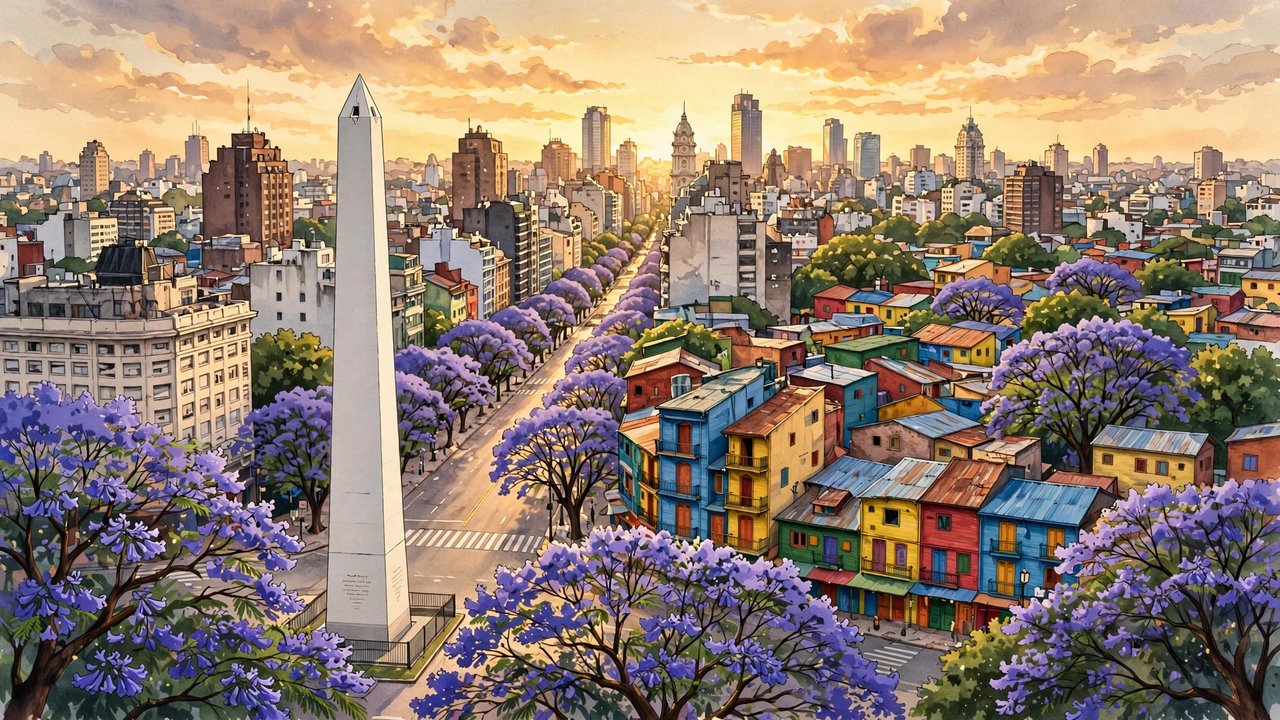
There is no single best month, because Patagonia and Buenos Aires want different ones. Patagonia is best from November to March, with long days, open trails and boat trips, and the strongest winds, the highest prices and the busiest trails in January and February; aim for November or March for the same season with fewer people. Buenos Aires is at its best in spring (September–November, when the jacarandas turn the streets purple) and autumn (March–May). The north-west is best from April to November, outside the summer rains. Iguazú is good all year. For a trip that combines Patagonia with the north, the two best months are March and November.
Visa-Free for 90 Days: Entry in One Paragraph
Citizens of the US, UK, Canada, Australia, New Zealand, every EU country, Japan, South Korea and most of Latin America enter visa-free for up to 90 days, free of charge, and can extend once for another 90 days at a Migraciones office before the first 90 days expire. Travellers who need a visa apply at an Argentine consulate before travel, and some nationalities holding a valid US or Schengen visa can use the online AVE authorisation instead. Full steps, the AVE and the consular route are in the Argentina visa guide.
Pros and Cons
The case for
- One of the best-value destinations in the world in 2026: $35 to 68 a day on a backpacker budget, with world-class steak for under $30.
- Patagonia is the best trekking in South America, and Iguazu is one of the great waterfalls on Earth.
- 90 days visa-free for most passports, free of charge, extendable to 180 days.
The case against
- The distances are the trip: internal flights are the biggest budget swing, and Patagonia costs 2 to 3 times the north.
- The peso moves fast, prices quoted in pesos last month may not hold this month.
- Buenos Aires in January is hot, humid and half-empty; Patagonia in winter largely shuts down.
Sources
- Wikipedia, Argentina (2022 census 46,044,703; area 2,780,085 km²; GDP $604bn nominal 2024; 23 provinces): en.wikipedia.org, checked 13 November 2026
- GlobeRove, Facts and Statistics for Argentina (Iguazu to Tierra del Fuego; soy, beef, wheat, wine, lithium; Italian cadence): globerove.com, checked 13 November 2026
- Mauritius Trade, Argentina presentation (Greater Buenos Aires ~15m; Cordoba, Rosario, Mendoza, Salta agglomerations): www.mauritiustrade.mu, checked 13 November 2026
- Travel With Hello, Argentina Travel Budget Guide (daily $35 to 60 / $80 to 150; 7-day $245 to 420 / $560 to 1,050): www.travelwithhello.com, checked 13 November 2026
- LatAm Travellers, Argentina Trip Cost 2026 (hostel $12 to 25 BA / $25 to 50 Patagonia; north 40 to 55% cheaper): latamtravellers.com, checked 13 November 2026
- Next Stop Anywhere, Best Time to Visit Argentina (Oct–Nov / Mar–Apr; Patagonia Nov–Mar; BA spring/autumn): next-stop-anywhere.com, checked 13 November 2026
- ConverterHub, USD to ARS (BCRA official rate about ARS 1,545 to 1,570 per dollar, 12 November 2026): converterhub.com, checked 13 November 2026
Facts checked: 13 November 2026. The peso rate moves fast. Recheck the live rate before you travel.